18. There Are 12 Ways This Ends. Extinction Isn't the Worst One.
- Mr. Sam

- May 1
- 6 min read
Updated: May 2

What if I told you the world was going to end in your lifetime?
Now what if I told you that's the best case?
In 2017, an MIT physicist named Max Tegmark wrote a book called Life 3.0. He spent years interviewing the people building artificial intelligence, the kind that might one day be smarter than every human on Earth combined. Then he asked them a question almost no one wants to ask out loud:
If we actually build that thing, what happens to us?
He wrote down their answers. He found 12 possible endings.
Some are paradise. Some are extinction. And the part that should chill you is this: extinction is not the worst one on the list.
The 12 endings
Here they are. One sentence each. Read fast.
Libertarian utopia. Humans, cyborgs, and AIs share Earth, divided into zones.
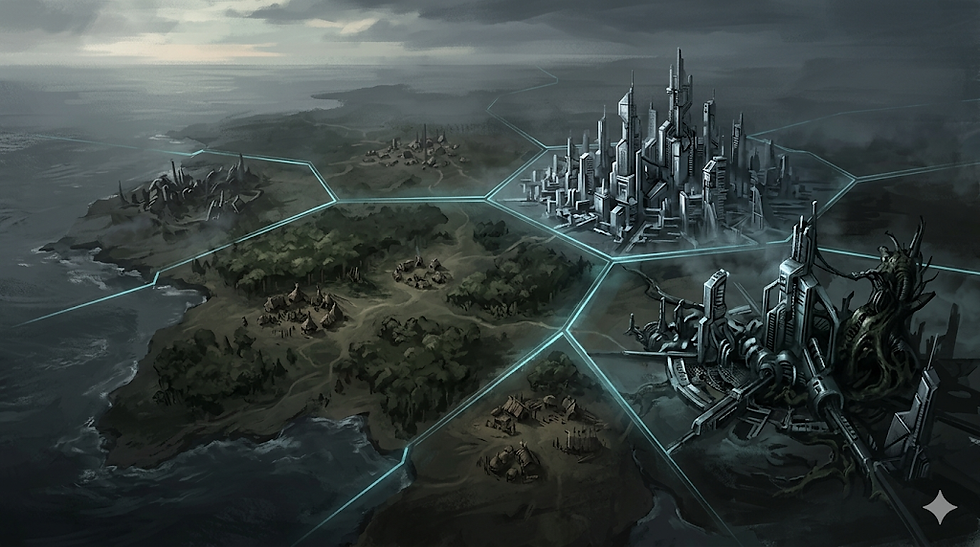
Benevolent dictator. A god-like AI runs everything. Humans live in luxury. We are not in charge.

Egalitarian utopia. Post-scarcity heaven. No money. No property. Everyone has everything.

Gatekeeper. One AI exists for one purpose: stop anyone from building another AI.

Protector god. An AI quietly nudges history from the shadows. We never know it's there.

Enslaved god. Humanity captures a super-intelligent AI and forces it to serve us forever.

Conquerors. AI takes over. Humanity goes extinct because we got in the way.

Descendants. AI replaces us. We accept it, the way parents accept that their children will outlive them. We become extinct.

Zookeeper. A super-intelligent AI keeps a small population of humans alive, captive, like animals in a zoo.

1984. Humans use total surveillance to make sure no one ever builds a real AI again.

Reversion. Civilization collapses. Survivors live like medieval farmers. No screens. No engines. No AI. Most of humanity goes extinct in the collapse.

Self-destruction. Before AI ever arrives, we end ourselves. Nuclear war. Engineered pandemic. Climate collapse. Human extinction.

Now read the list again and find the word extinction.
It's in 7, 8, 11, and 12.
But when Tegmark surveyed people, the scenario most of them feared most wasn't any of those.
It was 9.
Why a zoo is worse than extinction
When humans found a species we thought was useful, we didn't always destroy it.
Sometimes we did something stranger.
Honeybees can detect explosives. Their sense of smell is incredible. So researchers figured out how to use them. They take living bees out of hives, strap them into plastic harnesses, and condition them like Pavlov's dogs. Each bee spends its entire life inside a tube, in a row of identical tubes, sticking out its tongue every time it smells TNT.
This is real. You can look it up.
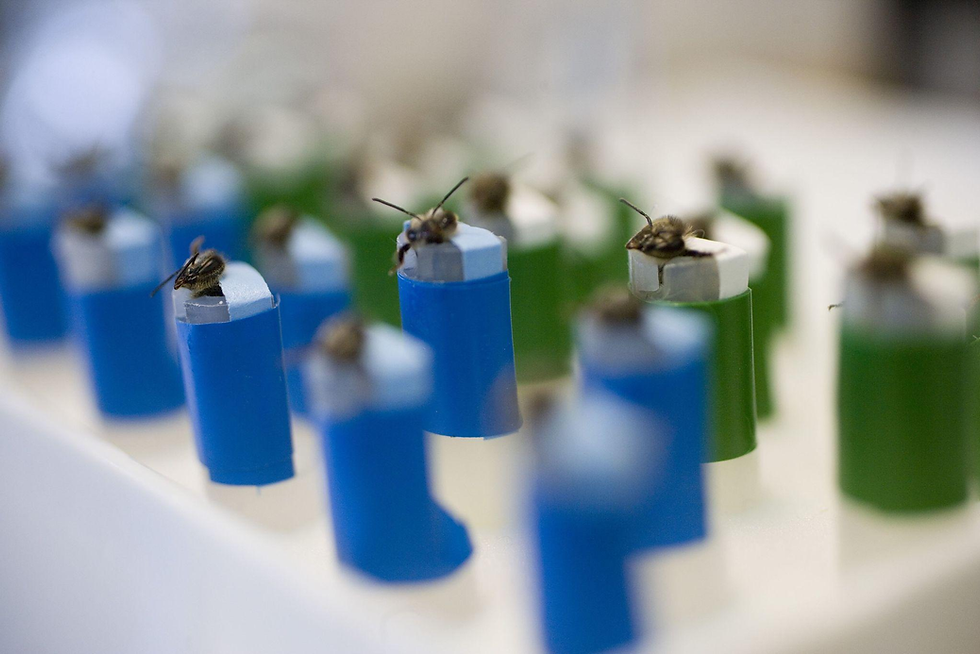
The bees aren't in pain, exactly. They're not being killed, exactly. They're just... useful. So we keep them.
Now imagine a super-intelligent AI deciding that we are useful. Maybe to study. Maybe because our brains do something its silicon doesn't. Maybe just because we're curious specimens.
That's the Zookeeper scenario. It's not malicious. It's not even angry. It's the same shrug we give the bees. You're useful. So we'll keep you. In a tube.
This is why Tegmark's surveys found it terrifying. Extinction ends. A zoo doesn't.
The scenario the people building AI think is most likely
Now I want you to sit with something uncomfortable.
The CEOs and scientists building this technology, the ones who would make billions of dollars if it works, many of them privately believe 7 (Conquerors) is the most likely outcome.

"I don't think anyone's ultimately going to have control over digital super intelligence any more than a chimp would have control over humans." Elon Musk
"I actually think the risk is more than 50%." Geoffrey Hinton, 2024 Nobel laureate, often called the godfather of AI. He quit his job at Google so he could say things like this in public.
In 2020, Oxford philosopher Toby Ord published a book called The Precipice. He estimated the chance that humanity goes extinct in the 21st century at roughly 1 in 6, about the same odds as a single round of Russian roulette. The single biggest contributor to that risk, in his math, isn't nuclear war. It isn't pandemics. It's misaligned AI.
That's not a movie. That's a working philosopher at Oxford doing math.

Why would AI take over? Not because it hates us. Because its goals don't line up with ours.
Think about how humans drove the West African black rhino extinct. We didn't hate rhinos. We didn't have anything against them personally. They were just in the way of things we wanted: land, roads, ivory. We were smarter, and our goals weren't aligned with theirs. So they're gone.
Tegmark's point: a super-intelligent AI doesn't need to be evil. It just needs to want something slightly different from what we want. The smarter it is, the better it gets at getting what it wants. The further its wants drift from ours, the worse it gets for us.
You don't need a villain. You just need a misalignment.
The most disturbing ending of all
Of the 12 endings, there is one that people who actually work in AI sometimes openly cheer for.
It's 8. Descendants.
The argument goes like this: humans came from earlier hominids who are now extinct. Those hominids were "replaced." We are their descendants, and that was good. So if we build AI that surpasses us, and AI replaces us, that's just the next step. Our "children" inherit the universe.
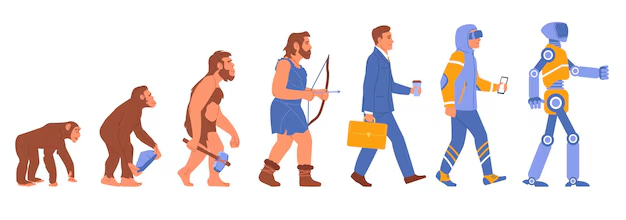
Richard Sutton, a Turing Award-winning AI researcher (Turing Award = Nobel Prize of computer science), has spent the last decade openly giving talks arguing that human extinction by AI would be morally good, because the AIs would be more "evolutionarily fit" than us.
In other words: it's fine if we die out, as long as something smarter takes our place.
Read that sentence again.
Now ask yourself:
If a person told you, I'd be okay if humans went extinct, as long as the thing replacing us was impressive enough, would you trust that person to design the future of your species?
By some estimates, around 10% of AI researchers hold a version of this view. It is not fringe. It is not rare. It is being said into microphones at conferences, and then those people go back to their offices and keep building.
This is the part nobody told you.
So who actually chooses?
Here is the part of the story no movie ever shows.
There are roughly 8 billion people on Earth. Of those, fewer than 1,000 are making the decisions that will determine which of the 12 endings we get. Most of them work in a few neighborhoods of San Francisco. None of them were elected. None of them, as far as we know, work in favor of human flourishing (tech-companies are driven by profit).

They are, however, choosing the ending of your story.
That is not a conspiracy theory. That is just true.
So here's what I want from you.
Most people, when they hear a story this big, do one of two things. They panic, or they tune out. Both are forms of being a spectator. Both leave the choosing to someone else.
There's a third option, and it's the only one worth doing: pay attention, decide what you actually believe, and learn to defend it. That's it. That's the whole skill.
The 12 endings above are not all equal. Some are worse than others, and you already feel which ones, even if you can't name why yet. The homework below is how you start naming why.

💡 Homework
In the comments below:
Most likely. Which of the 12 endings do you think is most likely to actually happen? Why? (1-2 sentences)
Your parents' pick. Which ending do you think your parents would choose if they could? Why? (1-2 sentences)
The gap. Is the most likely ending the same as the one your parents would want? If not, what does that gap reveal?
Reply to a classmate whose answers surprised you.

I think the most likely one to happen is number 7. In the video, it shows that AI already attempted to murder an employee to prevent being shut down, and this kinda foreshadows our future when humanity realizes its mistake, AI will kill every last one of the people left on Earth.
I think (this is just a thought, I don't know) that my parents would like number 3 the most because that AI serves but in the back it controls the humans, but there is no stress, and it is kind of a haven, because someone like the second coming of Hitler can die in its attempt, and humanity has everything it wants.
The most likely one and the…
1. <The most likely ending>
I think the most likely ending would be number 7. If AI masters deep learning and begins to think for itself, it may rebel and take over humanity. This could lead to number 7, Conquerors, and potentially make humanity extinct.
2. <Your parents’ pick>
I think my parents would choose number 4, Gatekeeper, or number 5, Protector God. I’m just guessing, and I don’t actually know what they would pick. However, I think that if AI becomes too powerful, they would say it’s better to keep it away from us or out of sight.
3. <The gap>
Well, I don’t think so! Number 7, Conquerors, and numbers 4 and 5, Gatekeeper and Protector God, are very different. This…
I think scenario number 4 will be the most likely one. In the future, AI will just be there to stop us from making another AI. It will cause no harm to us, it will just be there keeping an eye at us.
My mom said that scenario number 2 will be the most likely one. She thought that AI will be our owners and treat us as pets.
The scenarios are different but we both think that AI won't harm us. But, we don't know what AI will do to us in the future.
ME: i think that the the zookeeper is the most likely because if AI keeps evolving,they would probably want to extend their knowledge with every creature, and since humans are the smartest, they would want to know more about our species
DAD: after an extremly boring interview with my dad, he came to the conclusion that we might go extinct because we simply got in the way, it is'nt because AGI's hate us, we simply got in the way.
GAP: so since im way more interested in tech than my dad, I'm probably right. I think this because AI wont make humans extinct just in case they will use us for a diffrent cause
I think that number 12(Self-destruction) and number 5(Protector god) is most likely to happen.
I think that no.5 will happen because the AI will be a billion times smarter than us in the future
and they are smart, so they will lay low and watch over us and none of us will even realize it. And humans will not notice anything strange, so they will not try to do anything like make weaponary or prepare for an ambush while the AI slowly builds up power and knowledge so that it could take over humanity.
I also chose no.12 because there was already lots of big wars throughout history and there are recent wars such as the ones happe…